The Portfolio Is the Product
The Portfolio Is the Product
Ali Khan Design · Self-Initiated · Q2 2026
Most designers build a portfolio to show their work. I built one to demonstrate how I work — from scratch, with a custom design system, using AI as an execution layer rather than a design substitute. Under two weeks from first decision to shipped site.
12+
Pages built
< 2 weeks
Concept to shipped
90%
Hosting cost reduction
$0
External labor
My Role
Product Designer, Design Technologist
Methods
Product strategy, UX design, visual design, component-driven development, UX writing
Tools
Next.js, React, Vercel, CSS custom properties, Figma
Status
Shipped in under 2 weeks, concept to launch
The Context
Does your portfolio demonstrate how you work, or just describe it?
Every designer eventually has to answer that question. For a while, mine described it. I was on Squarespace, like a lot of designers. It was fine. It looked professional. It didn't embarrass me. But it also didn't do anything a hiring manager couldn't get from reading my resume.
The audit changed that. After spending time systematically evaluating Squarespace's AI design tools, I reached a conclusion I couldn't ignore: the platform was built for constraint, not expression. Its AI is a categorization engine wearing a personalization promise. And I had been using it to represent work that was, at its core, about breaking through exactly that kind of design mediocrity.
The decision to build from scratch wasn't impulsive. It was the logical endpoint of the research.
The Problem
Portfolio sites have a homogeneity problem
Not because designers lack taste, but because they all start from the same place. The same platforms, the same templates, the same AI tools making the same decisions. The output looks different on the surface and identical underneath.
The deeper problem is that most portfolio sites are deliverables. A designer finishes their work, then builds a container to hold it. The portfolio is an artifact of a job search, not a demonstration of how the designer actually thinks.
That framing gets the user wrong. A hiring manager isn't just looking at your work. They're trying to answer a specific question: can this person solve problems I haven't told them about yet? A portfolio that's just a gallery of past work doesn't answer that question. A portfolio that is itself evidence of product thinking does.
“The job to be done was clear: build something that demonstrates the work in the act of existing.”
The Research
The audit that made the decision inevitable
The foundation for this project was the Squarespace audit, documented as a separate case study. The short version: after testing Squarespace's AI-assisted design tools across two tracks, the platform's core failure was a gap between what it promised and what it could deliver.
Three findings from that audit directly shaped this build:
The Insight
Treat the portfolio like a product
The audit produced a diagnosis. The reframe was simple.
A product has a user — the hiring manager. A job to be done — get to the interview. And success criteria — does it move someone to reach out? It means research before decisions, not after. The design system isn't decoration, it's infrastructure. AI is a collaborator in execution, not a substitute for thinking.
This is not a novel idea. It's just rarely applied to personal work with the same rigor applied to client work. The gap between how designers treat their own portfolios and how they'd treat a client's product is where most portfolios fail.
“The portfolio needed to answer a question before anyone asked it: does this designer apply the same thinking to their own work that they'd apply to mine?”
The Design
Four decisions that shaped everything
Architecture first
The site is four pages: Home, My Work, About Me, and a footer-based contact section. Every navigation decision was made around the hiring manager's likely path, not around what a standard portfolio site includes. No dedicated contact page — a contact page implies the contact is the goal. The goal is the work. Contact follows from that.
The Honest Design System
Rather than using an existing component library, this site is built on a custom design system created specifically for this project. Honest is documented separately as its own case study. The short version: 39 components, a two-layer token architecture, full Figma-to-code parity, and a Storybook integration that makes the system auditable. Using a custom system meant every visual decision was intentional, not inherited.
Password-gated case studies
Detailed case study content sits behind a password gate. This was a deliberate product decision: it signals the work exists without exposing it to unqualified access, creates a natural filter for serious candidates and recruiters, and positions the portfolio as something worth protecting rather than something available to anyone.
AI as execution layer
Claude was used throughout the build for code generation, component architecture, copy editing, accessibility review, and typography decisions. The distinction that mattered: AI did not make design decisions. It executed them.
Every page structure, every content hierarchy, every token value was decided first. Claude's job was to close the gap between the decision and the shipped component. That's a different relationship with AI than asking it to design something and accepting what it produces.
“AI is a better collaborator when the human side of the collaboration is more rigorous. The quality of the output tracks the quality of the input — which turns out to be a design problem all the way down.”
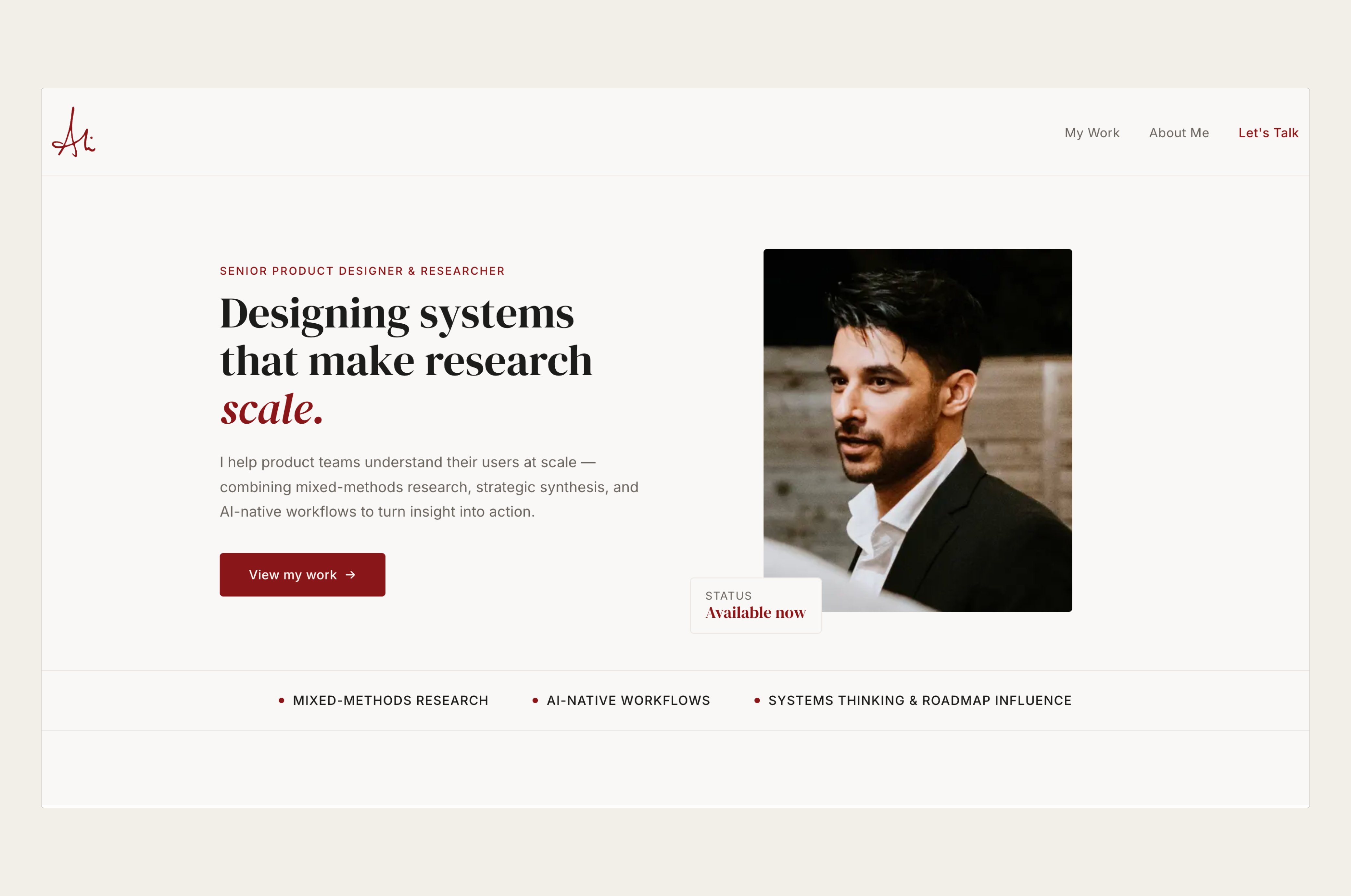
The finished site at alikhandesign.com. Four pages, one design system, zero templates.
The Outcomes
The site is the evidence
Squarespace at approximately $144 per year replaced by Cloudflare domain registration at $10 per year and Vercel on the free tier. The savings are modest in absolute terms. The ownership is not.
The site itself is the primary outcome. Not as a collection of pages, but as evidence: a designer who applies product thinking to every surface they touch, including their own professional representation.
The Reflection
The ceiling moves. The thinking has to move with it.
Building this site taught me something I already believed but hadn't tested against myself: the gap between knowing how to design and actually shipping something is where most of the real work happens.
I have basic HTML and CSS skills. I can build things, but slowly, and not always cleanly. AI changed the equation entirely. Not because it designed anything for me, but because it removed the bottleneck between a decision and its implementation. Anything I could clearly specify, I could ship. That's a different kind of design leverage than I've had access to before.
What surprised me was how much the product thinking framework clarified the AI collaboration. When you know exactly what you're building and why, prompts get sharper. The honest version of what AI-native workflow looks like in practice isn't a designer who prompts their way to finished screens. It's a designer who thinks more clearly because they're not limited by execution constraints.
I built this while job searching, after a layoff, with no external accountability. The site exists because the product thinking framework made the scope manageable. It shipped because it had a product definition. That's the whole argument.
Interested?