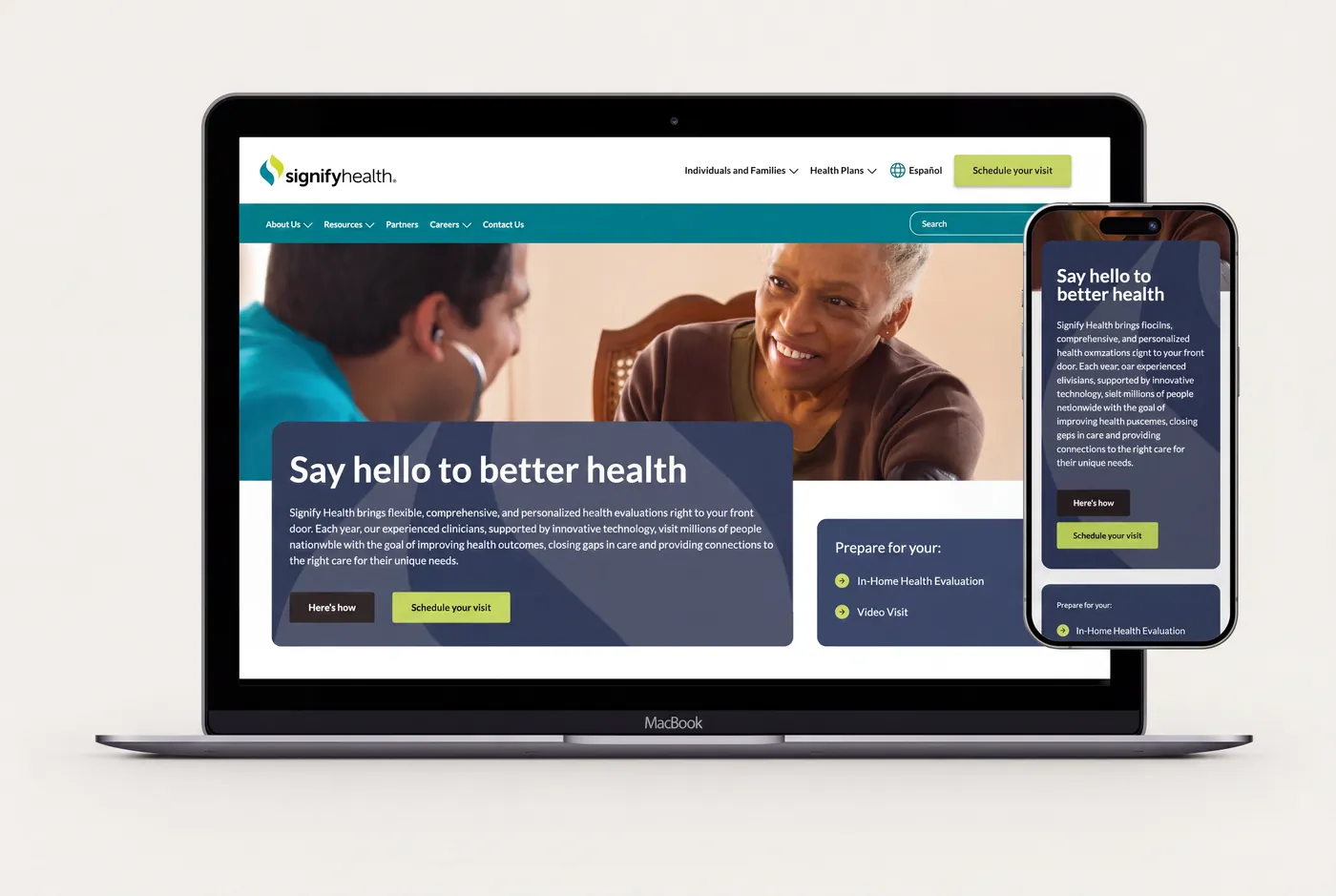
IHE Scheduling Portal
IHE Scheduling Portal
Signify Health · Member Experience · Q4 2022
A free in-home health evaluation sounds like an obvious yes. A licensed clinician comes to your home, reviews your medications, checks your vitals, and coordinates with your doctor, at no cost. So why were millions of eligible members saying no?
73 NPS
Post-visit satisfaction
2M+
Annual IHEs completed
8
Barriers to enrollment identified
My Role
UX Researcher & Designer
Methods
Qualitative Interviews, Thematic Synthesis, Value-Led Information Architecture
Tools
Google Meet, Adobe XD, Miro
Status
Shipped redesigned scheduling portal
The Context
A free service backed by real scale
Signify Health partners with health plans to offer eligible Medicare members an in-home health evaluation (IHE) at no cost, as part of their existing plan benefits. A licensed clinician visits the home, reviews medications and medical history, checks vitals, and reports findings back to the member's primary care provider. The program operates at real scale: more than 2 million evaluations a year, delivered by a nationwide network of licensed clinicians.
The population this program specifically reaches generally scores poorly on social determinants of health: income, transportation access, and housing stability, the non-medical factors that already make getting care harder.
Signify Health also offered Social Care Coordination (SCC), a separate service connecting members to non-medical support like transportation and help paying for prescriptions. SCC was enrolling members at a noticeably higher rate than the IHE. At the time of this project, the two had been consolidated: a clinician completes the IHE, then determines during that same visit whether the member has needs SCC could resolve, making the clinician the primary coordinator rather than SCC a separately scheduled appointment.
The Problem
A split in acceptance no one could explain
Too many eligible members were declining a free In-Home Health Evaluation that, by every available measure, benefited them. Yet those same members were actively enrolling in Social Care Coordination, a separate, non-medical support offering. The contrast was the real mystery: a population willing to accept social help was firmly shutting the door on clinical care.
No one on the team had a validated answer for why. Before any redesign could target the true barrier, we had to figure out what SCC was doing right that the IHE was getting wrong.
Interested?