LLM Prompt Engineering for Website Audits
WTW · Individual Marketplace · Q3 2025
The organization had a definition of "legal" but no definition of "done" — quality checks stopped at accessibility compliance, so unpolished work shipped and stayed shipped. I built an AI-driven audit engine that turned four departments' buried standards into a live, weighted scorecard any team could run in seconds.
My Role
Prompt Engineer, Systems Designer, Process Designer
Methods
Rubric design, cross-disciplinary standard-setting
Tools
Microsoft Copilot (Edge sidebar)
Status
Shipped cross-functional audit engine (UX, engineering, accessibility, content)
The Brief
A scalable way to enforce standards across four disciplines
The initial ask was for UX audits — a way to check pages against design standards without relying on one person's manual review. During discovery, I found the same gap existed in engineering, accessibility, and content strategy: standards existed, but they were buried in documentation nobody had time to cross-reference mid-sprint. I proposed expanding the project into a unified auditing system covering all four disciplines.
The Problem
A culture of compliance, not quality
The organization only enforced audits for legally mandated accessibility checks, so design and content standards carried no institutional weight. Developers could bypass documented patterns under deadline pressure, a single writer was responsible for maintaining a unified voice across years of content, and there was no official record of non-legal defects — so functional-but-unpolished work simply stayed in production. Quality was treated as optional because no one was accountable for it.
The Process
Engineering context, not just prompts
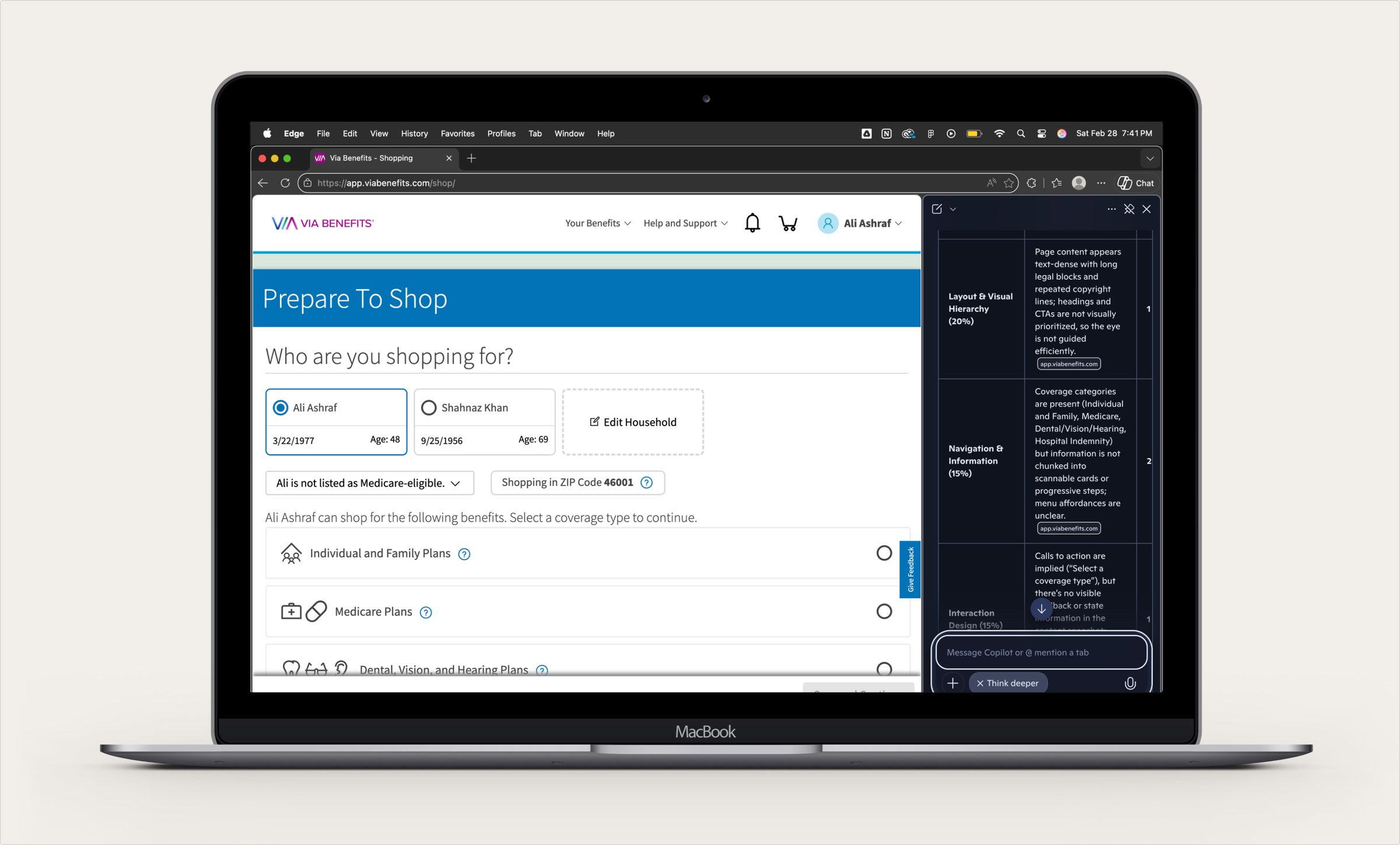
I deconstructed the internal Quality Knowledge Base — UX, engineering, accessibility, and content standards — into structured context specs for Microsoft Copilot, building in logic that reflected our actual business rules rather than generic AI feedback: weighting Medicare content for a 5th-grade reading level, for example, while allowing more technical nuance elsewhere. Each audit scored a page from 0–100 using a weighted rubric with a 0–3 severity scale, from blocker to full alignment.
I deployed the specs as a zero-friction toolkit inside the Microsoft Edge sidebar, so any team member could run a discipline-specific audit directly on a live page — no separate tool, no waiting on manual SME review.
The Solution
From reactive compliance to proactive, cross-functional accountability
The audit engine cut page review from hours of manual cross-referencing to minutes of automated synthesis, and gave leadership an objective, data-driven map of where design and technical debt were concentrated. It also democratized expertise that had been bottlenecked in one or two people — content strategy especially — by making it accessible to every department through a shared prompt library.
The bigger shift was cultural: once every team was scoring against the same 0–3 standard, quality feedback stopped feeling like personal critique and started reading as shared, objective data.
Interested?